

The Journey Map
The Journey Map is an integrated allegorical framework for individual and communal spiritual journey. It is intended to produce mission-saturated transformative movements. Drawing from ancient texts, centuries of spiritual practice, and hundreds of active case studies, the framework illustrates a “map” for change-agents to understand their position in the spiritual landscape and the possibilities for transformative experience and action.
The Journey Map describes The Three Lands and The Seven Places of journey. It also includes Four Transitions that mark crossings into and out of the Lands. Just like any map, The Journey Map should be interpreted as descriptive rather than prescriptive: it’s more useful for understanding the contours of the spiritual journey than it is for telling people how to have one or where to go. This means people may move freely any direction on the map, though there are “paths” that are historically “well worn” or typical, and the map can provide insight into how to get from point A to point B.
Where to Start?
The Journey Map is designed to be comprehensive and rich — but it can feel a bit complicated trying to take it in a single bite. We recommend thinking through the framework in it’s simplest form: The Three Lands — and then adding layers once you get the hang of things.
The Complete Framework
The Journey Map is presented below in a table format with links to explanatory pages.
| The Land of Belonging | The Land of Becoming | The Land of Believing | |
|---|---|---|---|
| (α) Heaven | |||
| Entrance: Incarnation | 2. The Story Zone holding the tension between aspiration and situation | 4. Growth Journey patterns the build relationship and capacity | 6. Movement manifesting the new reality through sentness in inhabitable ways |
| 1. Mercy Mission opening space for spiritual journey | (∴) Immersion irreversibly incarnating a change in identity | (✛) The Cross irreversible rebirth into a new reality | Exit: Iteration |
| 3. Revelation Rhythm excavating truth; God changing scope and showing the path | 5. Calling Into Gifts flow practices that hone style, gifting and calling | 7. Multiplication broadcasting seed-shaped experiences for new people and places the enter the story | |
| (β) Earth |
See The Journey Map explained in the this video (ChunkyMap version).
The Journey Map can be articulated as a “Napkin Drawing” like this — with positions on the map described as the main activity of all participants:
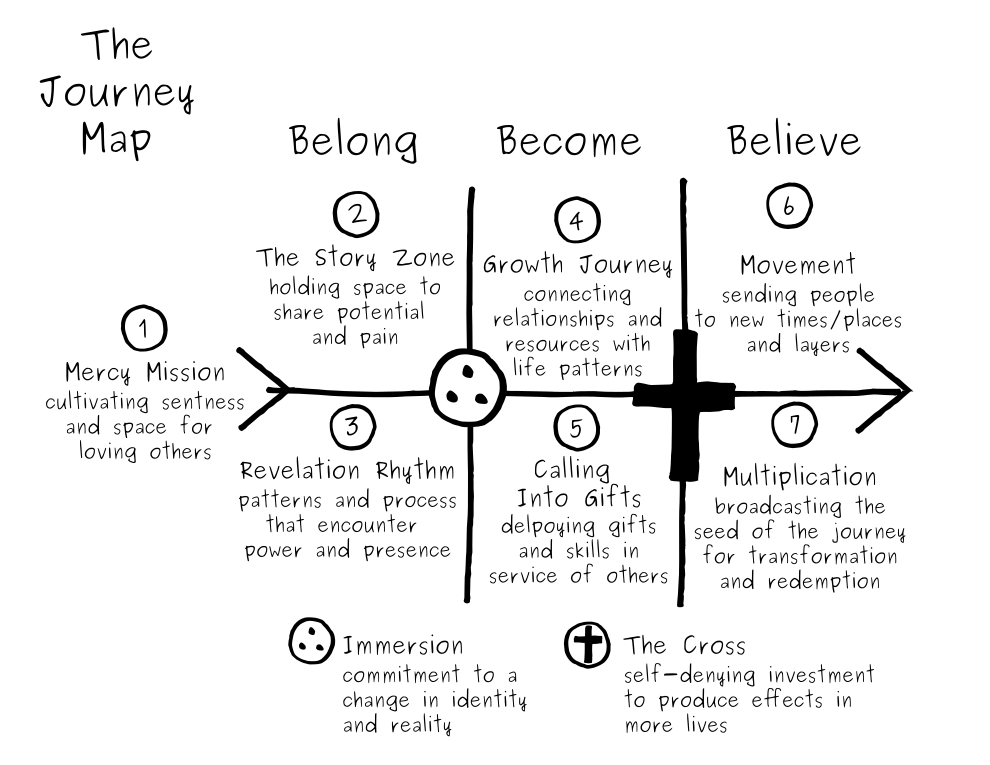
As an allegorical framework, The Journey Map describes personal development through pursuit of mission in a way that helps groups and individuals:
- position themselves on their spiritual journey
- discern what actions are critical
- learn and practice essential skills
- manage change towards greater incarnation of spiritual realities and greater manifestation of “the world that ought to be” both inwardly into our souls and outwardly into the world.
The map is used by matching the “shape” of an individual or groups’ experience to positions on the map. These positions categorizes objectives, tasks, and tools for people in is area of their journey.
Versions & Adaptations
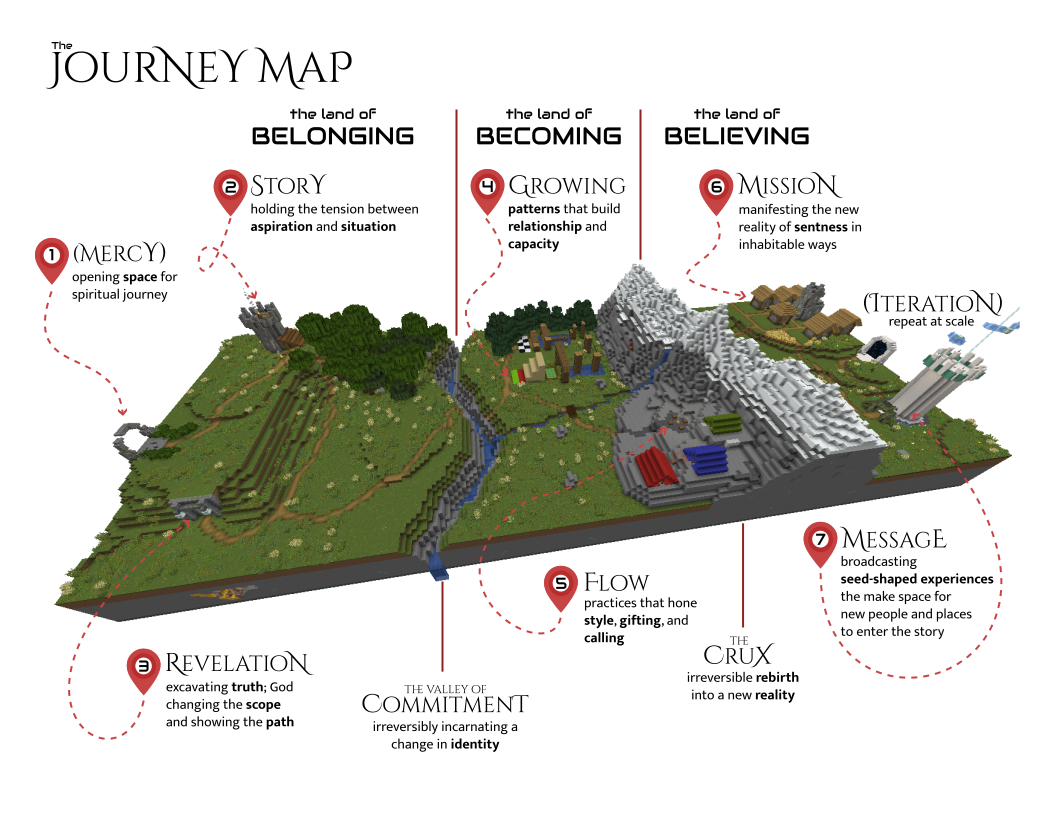
ChunkyMap
A gamer-flavored version with visualizations from Minecraft.
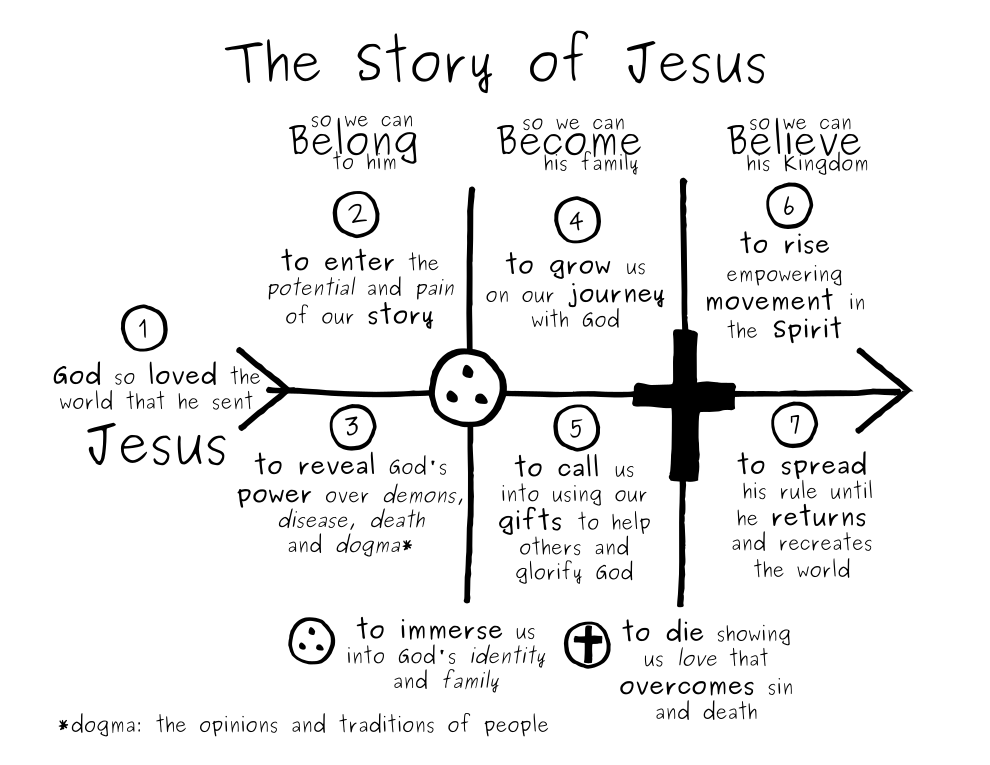
The Story of Jesus
A “Napkin Drawing” telling of the Gospel of Jesus based on Luke and Acts according the The Journey Map.
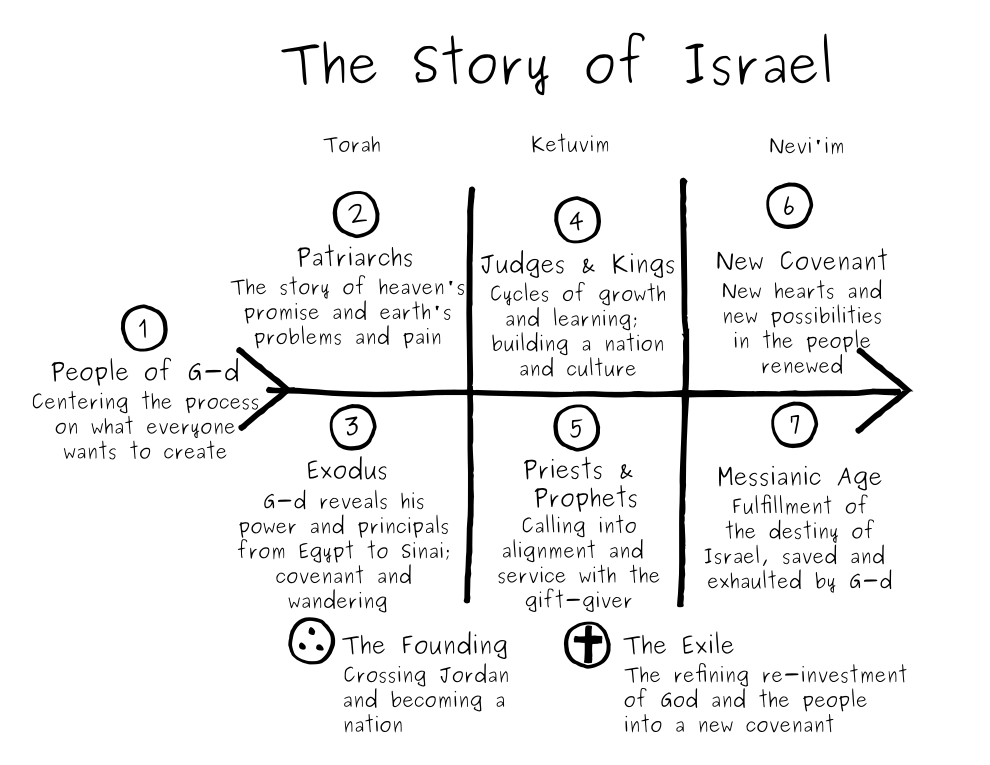
Adaptations
[7] The Spiritual Journey

Adaptation of The Journey Map to the individual spiritual journey according to the Way of Jesus.

Meta
The Journey Map was developed as a tool for discipleship and missional community by the UnusualKingdom PraxCom while working simultaneously on Mágoulo’s School for the Spiritually Gifted and the Awakened Village project. It was built from the foundation of The Way of Jesus framework for the life and ministry of Jesus, which allegorically identifies key movements for communities and individuals on a spiritual journey. Skills and activities were then developed to contextualize the allegory to missional-discipleship in post-church and post-modern contexts using the Frames of Systems VS and Universe VS. This contextualization also makes use of the Semantic Ontology Framework (SOF) for systems design and sustainability.