

[5] The Star
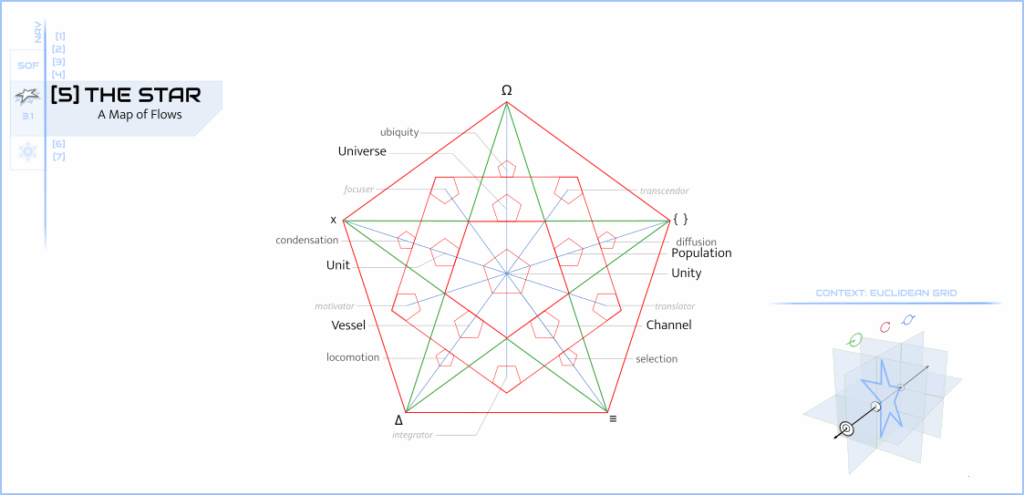
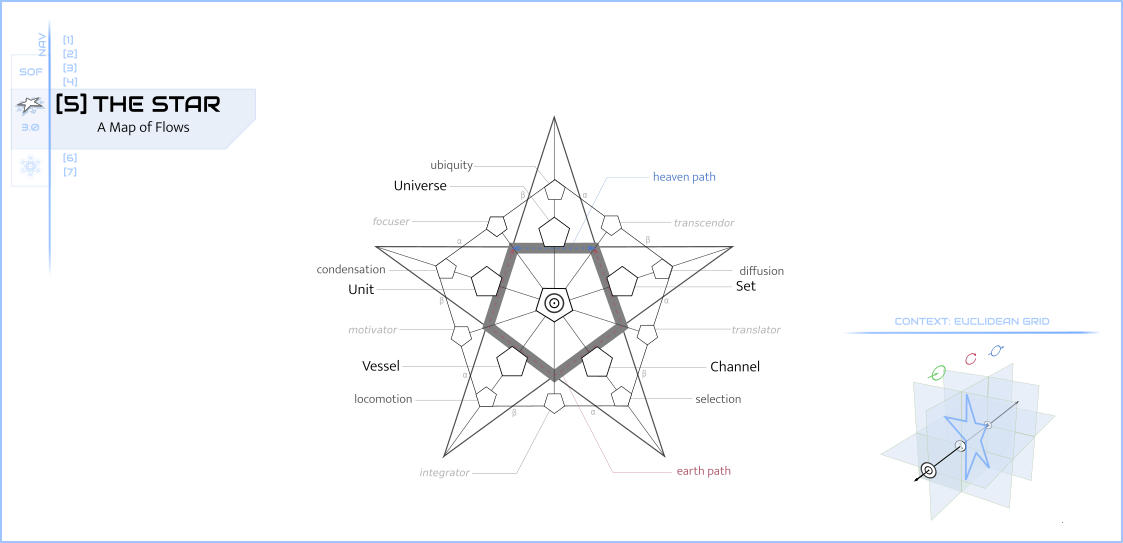
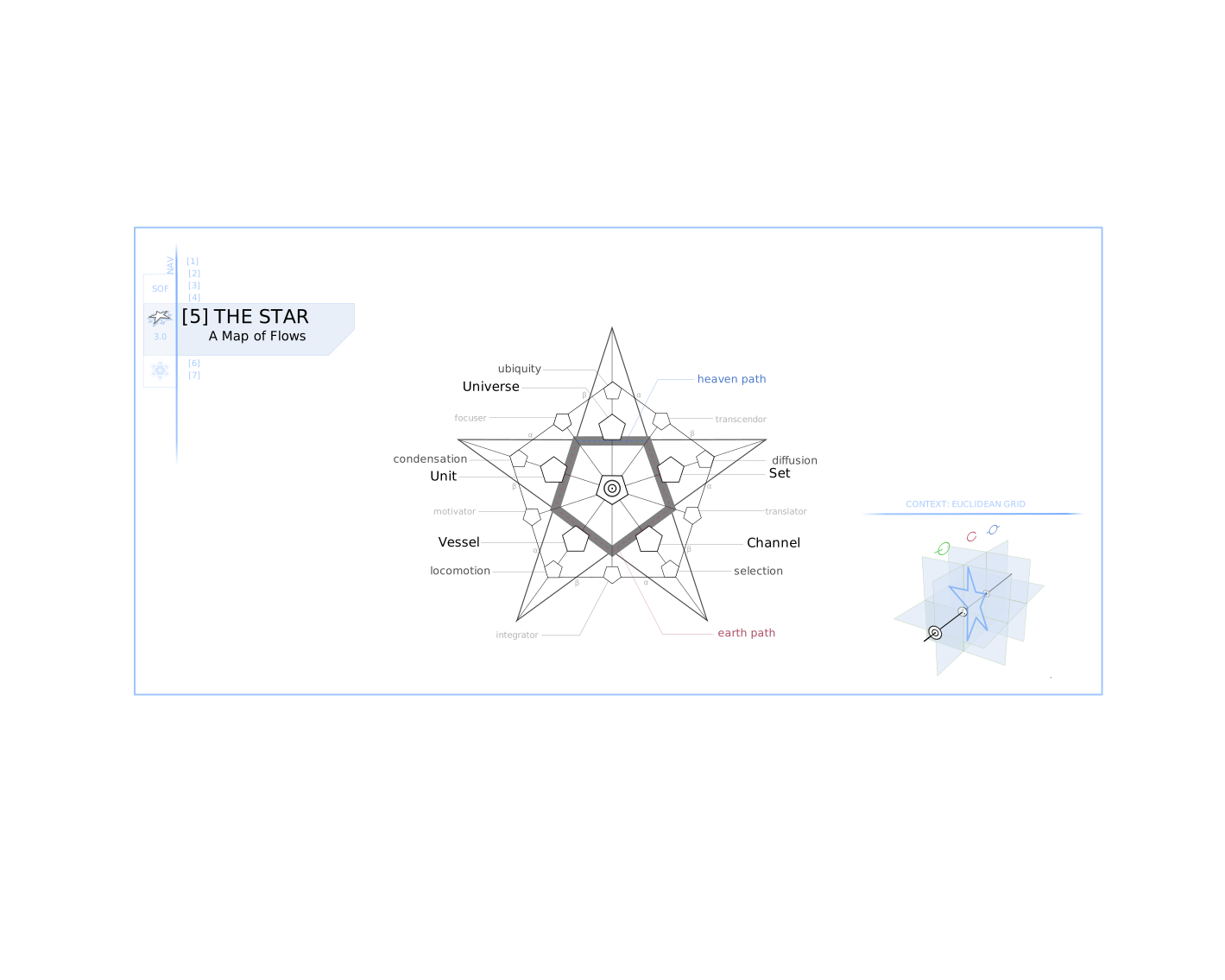
The Star is the fifth systems shape of Systematics and models how flows connect and work within a complex adaptive system. Like the forth shape, this frame can be thought of as within but not wholly dependent on shapes 1-3. In other words, “stars” of different systems of flow can be thought to move around within a single system and between systems. Generally, when flows are oriented in a way that is healthy for the over-all system, at least one Drive/Prime-line of this shape would align to the Prime of the over-all system. When flows are oriented to take a controlling role in the system, the Omega Drive/Prime line should be oriented to the Prime line of the over-all system.
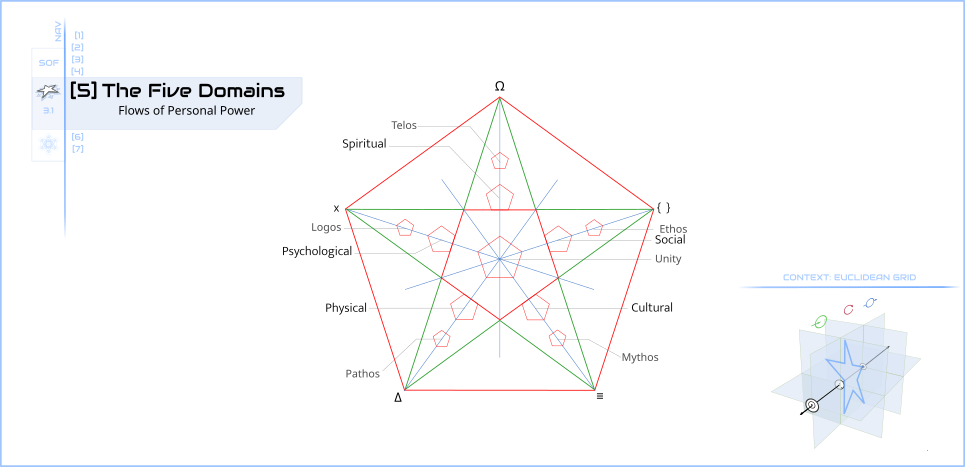
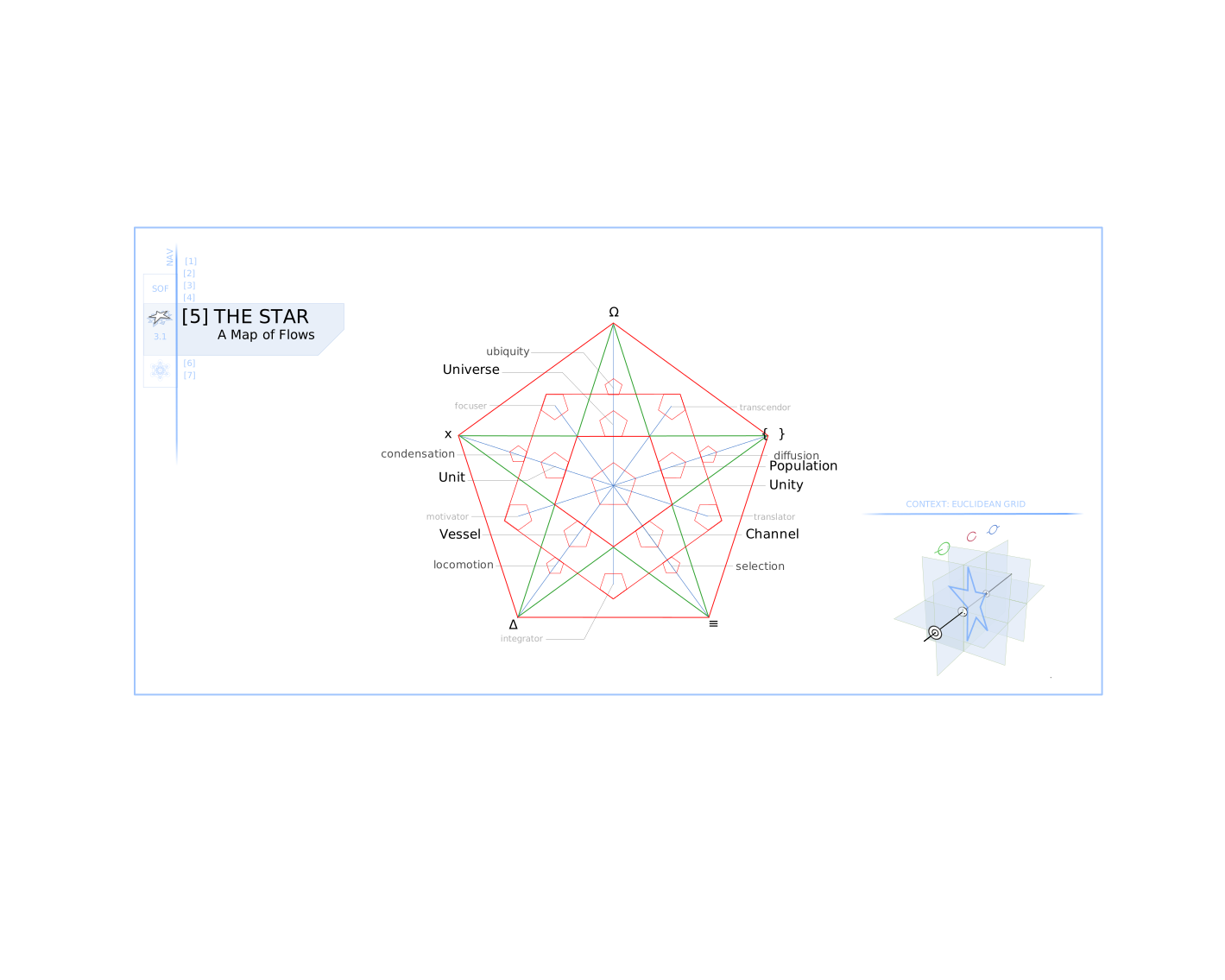
The Star does not imply a system will have only 5 components involved in flow. Instead, it describes five somewhat distinct types of flow-motion in a system in relation to any number of components. Like any Frame, this is a simplification necessary for symbolism and not necessary reflected in real-world structures. The origin case where [5] The Star was developed was [5] The Five Domains, which was an attempt to map the flows of human agency in different areas of life: the domains. Later it was noticed there was a allegorical connection to these domains and “the 5 elements of communication theory” — sender (x), message (Δ), channel (≡), receiver ({ }), and feedback (Ω) — which is, in itself, an application of agency. These two examples lead to a generalization of flows in all systems along basically geometrically fractal lines.
In this frame, workflows are thought of as Cycle motion and are represented by red pentagons. Source flows are represented by green stars. Drive flows, which align to Prime Lines bisecting points of the pentagons and stars, are represented as blue asterisk lines. In many systems, the flows represented by each line would be bi-directional, though this is not always the case.
The position and scale of objects is set by [5] Pentagram Penrose — a exploration of Penrose tiling using geometric nested pentagrams. This means there can be a nearly infinite number of nested objects on internal pentagons, especially as the outer edge of the frame is approached. In the case of the classic example above, three levels of nesting are shown.
Derivatives and Examples
[5] The Five Domains
[5] The Five Domains show the flows of personal power available to individuals using [5]…
Calling Into Gifts
Calling Into Gifts (Mashup) describes the fifth of The Seven Places of The Journey Map…
[5] Pentagram Penrose
Pentagram Penrose is a frame related to [5] The Star systems shape of Systematics that…
[5] Equip Me Eval
Equip Me Eval is an evaluation tool designed to probe the current fruitfulness of one’s…
[5] Org Star
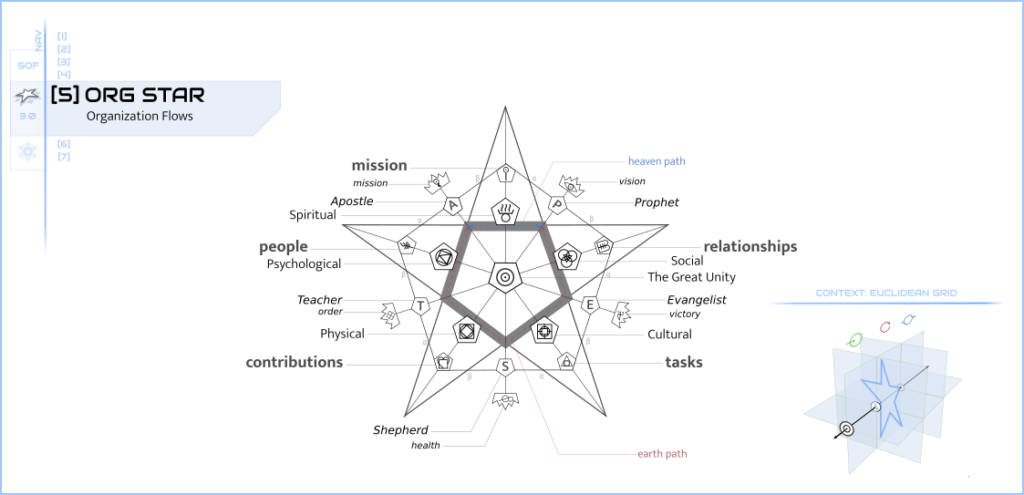
Org Star interprets the [5] Equipping Gifts of Ephesians 4 to teams in organizations based…
[5] The Equipping Gifts
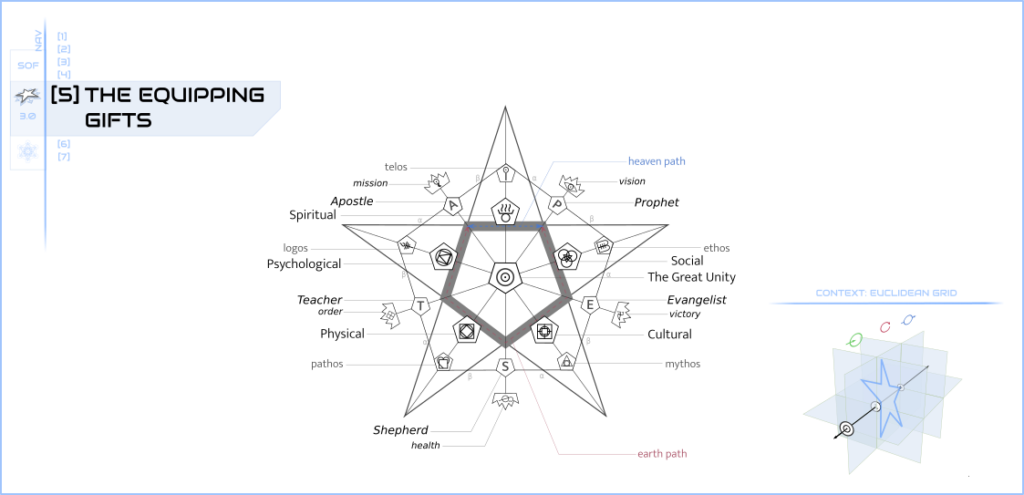
The Equipping Gifts is a frame that interprets the equipping gifts or function from Ephesians…
Media
Meta
[5] The Star was first articulates as a map of “human flows” based on [5] The Five Domains. The first version did not use a star, but was rather laid out on a version of da Vinci’s Vitruvian Man. This was called “The Whole Human” and was used by consulting firm MuddyHudson to articulate how organizations could benefit from allowing stakeholders to draw from more domains than typically allowed in secular institutionalized Western culture.
Eventually, The Whole Human evolved into a star and the five equipping gifts from Ephesians 4 were added, becoming [5] The Equipping Gifts. The star shape allowed the star to be “disassembled” virtually when talking about a single gift, and then “reassembled” when talking about five-fold teams.
As understanding of [5] The Equipping Gifts grew with practice, it was realized that the gifts represent a fundamental shape of flows in systems and the current version of [5] The Star was developed to generalize the shape for all complex adaptive systems.